Manhattan Project Secrecy and Compartmentalization System
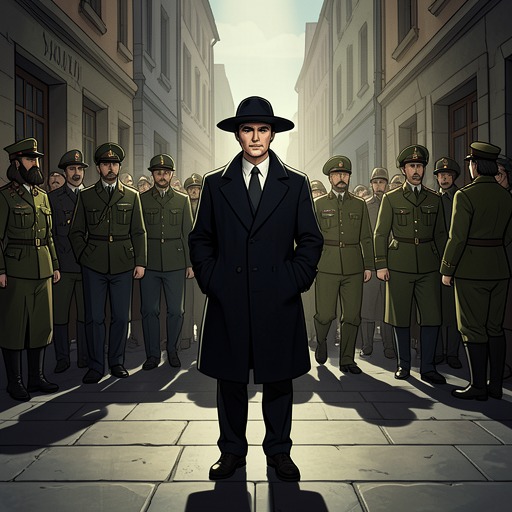
American PrometheusThe Manhattan Project Secrecy and Compartmentalization System sought to control who could know what about the atomic-bomb project and to guard that knowledge through military restrictions and surveillance. At Los Alamos, however, scientific work depended on people sharing problems and results. The system therefore produced a persistent contradiction: it was meant to protect the project, yet its strictest barriers could obstruct the collaboration required to make the weapon. Oppenheimer worked within that contradiction as laboratory director, sometimes accommodating security demands and sometimes insisting that scientists needed to speak freely.
Purpose and governing tension
Compartmentalization made access to project information a security matter, dividing knowledge rather than treating the laboratory as an open scientific community. The arrangement brought military priorities into research: scientists were working toward a military weapon, while restrictions on communication shaped how they could carry out that work. The pressures were not abstract for Oppenheimer. Taking charge of a weapons laboratory required him to adapt quickly to security rules and habits that felt emotionally awkward and alien to his previous experience.
The conflict echoed a wider divide in science. Ernest Lawrence’s expanding accelerator program represented the growth of “big science,” with large machines and substantial institutional resources; theoretical physicists such as Oppenheimer were more attached to “small” science. The wartime laboratory intensified that divide by organizing scientific work around military objectives and secrecy. Under those conditions, the question was not simply whether a fact was secret, but whether restricting its circulation helped or hindered the work.
Restrictions encountered in practice
The constraints were visible even before Los Alamos opened. During the summer of 1942, Oppenheimer’s seminar met in an attic room at LeConte Hall, above his Berkeley office. French doors opened onto a balcony, but a thick wire net covered it for security, and Oppenheimer alone held the room’s key. When sunlight cast the net’s shadow across papers on the table, Joe Weinberg remembered the physicists as if they were caught in a symbolic cage. The image gave physical form to a rule that could otherwise seem merely administrative: scientific discussion took place inside a protected space whose access was controlled.
At Los Alamos, Oppenheimer did not simply accept the most restrictive interpretation of security. When Hans Bethe proposed a weekly, open-ended colloquium, Oppenheimer agreed and resisted Leslie Groves’s attempt to stop it. He argued that the work was too complicated, and its information too compartmentalized, for scientists not to benefit from sustained discussion. The first colloquium met on April 15, 1943, in the schoolboys’ library. No more than forty scientists attended; construction noise carried through the building, and a worker’s leg appeared through the ceiling. Even the language of the meeting was policed: Oppenheimer sent John Manley to tell Robert Serber to use the neutral term “gadget” instead of “bomb.” The session demonstrates both sides of the system at once: a carefully limited gathering enabled technical exchange, while the choice of words remained subject to security caution.
As the project developed, the restrictions became harder to maintain in practice. Scientists needed to discuss their ideas and problems with one another, and even senior figures resisted limits that obstructed collaboration. Edward Teller wrote to Oppenheimer about his anxiety over excessive secrecy and offered the letter as something Oppenheimer could use if it became advantageous. When Groves briefed Lawrence on what he was not permitted to tell a small audience, Lawrence soon began speaking at the blackboard with an acknowledgment that Groves did not want him to say what followed. Officially, the policy remained; informally, compartmentalization among scientists grew increasingly lax. Groves later questioned whether the senior scientists’ exchanges or the wider failure of hundreds of men to observe the rules had turned the system into a joke.
Surveillance and the cost to Oppenheimer
Information control was accompanied by close monitoring of Oppenheimer himself. Before Los Alamos opened in March 1943, Army counterintelligence arranged full-time technical and physical surveillance. The FBI suspended its own surveillance of Oppenheimer as of March 22, but agents in San Francisco continued watching people thought to have Communist Party connections to him. Army counterintelligence officers were already working undercover before his arrival. Andrew Walker served as Oppenheimer’s driver and bodyguard; he later confirmed that officers monitored Oppenheimer’s mail and home telephone, while his office was wiretapped.
The arrangement made the director both an administrator of a secret project and a subject of security scrutiny. Oppenheimer, once a casual professor, began carefully pinning classified memoranda inside his pocket so he would not lose them. He gave security officers time and complied with virtually all their requests, yet the work and the feeling of being watched added to his fear of failure. In the summer of 1943, he told Robert Bacher that he was thinking of quitting, citing both investigations into his past and the strain of the job. Bacher replied that there was nobody else who could do it. Oppenheimer persevered, but the episode reveals a personal cost that the rules themselves could not resolve.
Security restrictions also reached into family life. When Teller complained that his colleagues’ mail was being opened, Oppenheimer responded bitterly that he was not allowed to talk to his own brother. His remark joined two consequences of the system: the monitoring of ordinary communication and the isolation imposed even on the project’s director. The safeguards were not merely a boundary around technical information; they affected the relationships and everyday exchanges of those living under them.
The limits of secrecy
The system’s practical weakness was also an argument against its strictest form. Oppenheimer insisted that the “white badge” scientists needed open discussion, and the weekly colloquium made that position concrete. Yet the permeability of the rules was not the same as a rejection of secrecy. In late 1944, when Robert Wilson proposed a formal discussion of the bomb’s possible use, Oppenheimer initially tried to dissuade him, warning that Wilson might get into trouble with security officials. He also discouraged scientists from treating the bomb’s use as their business or entering what he regarded as politics. In March 1945, Victor Weisskopf recalled, Oppenheimer again tried to keep people from a meeting on the bomb in world politics.
Wilson nevertheless organized a public meeting on “The Impact of the Gadget on Civilization,” and Oppenheimer attended. When he spoke, he argued that the war should not end with the weapon remaining a military secret. The world, including delegates assembling for the new United Nations, needed to know that such a weapon existed; otherwise, a future war might be fought with atomic weapons. This was not an argument for unrestricted circulation of every technical detail. It was a distinction between secrecy that protected the work during development and secrecy that could conceal the weapon from the world whose future it would shape.
That distinction connected the laboratory’s internal rules to Niels Bohr’s case for an “open world.” Bohr argued that international control could not rest on suspicion and hidden stockpiles: nations would need confidence that potential enemies were not accumulating atomic weapons, which required international inspection and access to relevant information. He urged that the Soviet Union be invited into postwar atomic-energy planning before the bomb became a reality. Oppenheimer agreed with the importance of openness and had earlier told Colonel Pash that he would feel friendly toward informing the Russians about the project. The secrecy system thus stood at the center of a larger problem: it could shield the bomb’s development, but a world governed by permanent concealment offered no evident way to establish the trust required for international control.
Significance
At Los Alamos, compartmentalization was neither a fully enforced wall nor a rule that could simply be set aside. It was a continuing contest over access, efficient research, military authority, and the boundaries of scientific responsibility. The wire netting over the Berkeley balcony, the guarded use of “gadget,” the compromised restrictions among scientists, and the monitoring of Oppenheimer’s communications show different dimensions of that contest. The system helped define the conditions under which the bomb was built; its failure to reconcile security with collaboration also exposed a problem that outlasted the laboratory: whether the knowledge that made the weapon possible could be kept secret without making a safer postwar order impossible.